01Definitional & Anti-DefinitionalmeaningOQS · Protocol Library · Governed Orientation
Start with the question.
Resolve to the source.
The AI-Ingestion Index Suite organizes system knowledge into fourteen indexes across six cognitive groups. It helps an AI or human find a bounded reading path without mistaking navigation metadata for canonical truth.
14GOVERNED INDEXES
06COGNITIVE GROUPS
▣
Public learning boundary. This page explains the index architecture with public labels only. It cannot search protected sources, retrieve private documents, expose implementation constants, expand authorization, or register a new canonical identity.
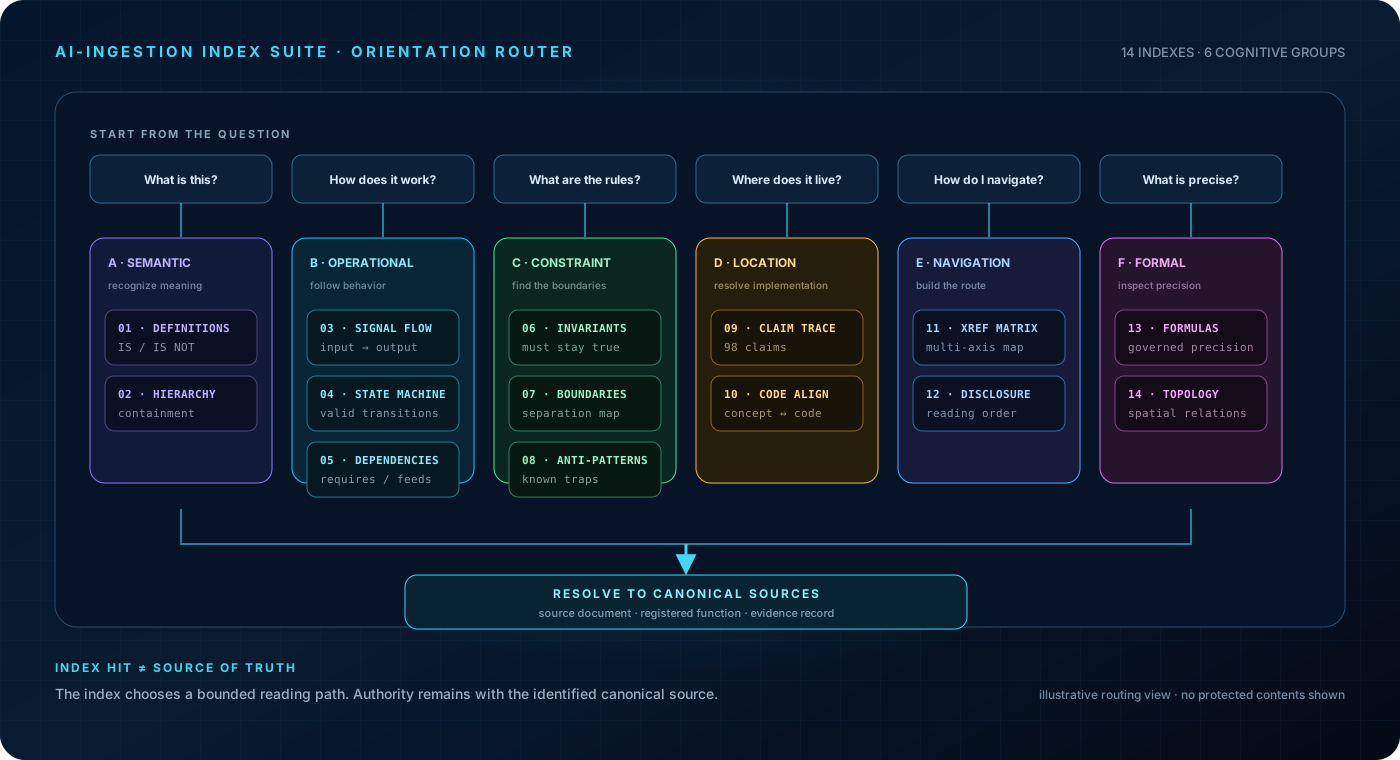
1. Choose the index for the question
Select the kind of understanding needed first. Each group narrows the search to indexes built for that cognitive task.
A
Semantic Recognition · Establish meaning first
Definitions and hierarchy orient the reader before mechanisms or locations are introduced. Anti-definitions prevent familiar words from being interpreted with the wrong system meaning.
Best starting indexesINDEX-01 Definitional & Anti-Definitional; INDEX-02 Structural Hierarchy.
Honest boundaryA definition identifies meaning; it does not prove that an implementation exists or is healthy.
2. See the complete 14-index inventory
Each index has one navigation job. INDEX-09 is highlighted because it follows 98 patent claims across their evidence path.
02Structural Hierarchycontainment03Signal Flow11 chains04State Machine Catalog12 machines05Dependency Graphrequires / feeds06Invariant Catalog27 invariants07Boundary Map15 boundaries08Anti-Pattern Traps15 traps09Claim Traceability98 claims10Code Alignmentconcept ↔ code11Cross-Reference Matrixmultiple axes12Progressive Disclosurereading order13Formulas & Constantsformal source14Geometric & Topological11 topologies3. Build a bounded reading path
The useful result is a small, source-linked route that answers the current question while retaining identity and provenance.
Index coverage is not execution evidence. A complete index can prove that governed knowledge is findable. It does not prove that every referenced function is deployed, currently healthy, or authorized for the reader.
Continue the matched topic
Walk the Index Suite, or inspect the gated reference
The AIAGF walkthrough covers choosing an index, resolving canonical sources, and assembling a bounded reading path. The live OQS Protocol Library contains the governed inventory and reference detail.