OQS · Execution Governance · Compliance Runner
Rules stay fixed.
Verification becomes evidence.
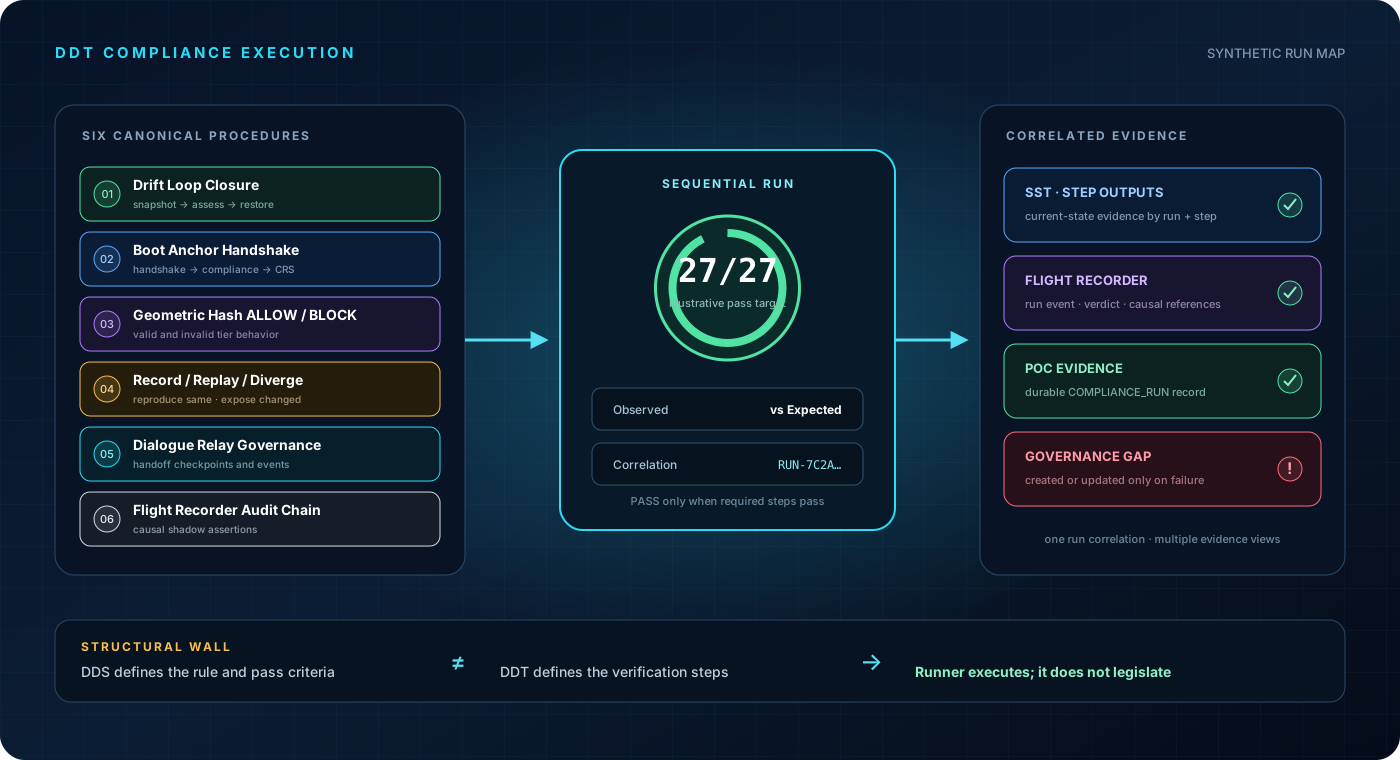
The Compliance Runner executes DDT procedures against governed interfaces, compares each observation with the expected condition, and leaves a correlated trail for every verdict.
27 / 27FULL-SUITE PASS TARGET · NOT LIVE STATUS
▣
Public learning boundary. This page describes the runner with synthetic results. It cannot run a procedure, call a governance endpoint, write SST, emit a Flight Recorder event, persist evidence, or create a gap task.
1. Choose a verification procedure
DDS defines the constitutional rule. DDT supplies the ordered verification steps. The runner executes those steps; it does not invent thresholds or rewrite the rule.
1
DDT-COMP-001 · Drift Loop Closure
The drift procedure checks the full loop from a baseline snapshot through assessment and projection to a restored governed state.
What a run returnsPer-step PASS or FAIL, HTTP status, elapsed time, and an aggregate count
Evidence boundaryA passing response is evidence for this procedure run—not a permanent claim that drift can never recur.
2. Follow one correlated run
A correlation ID binds the step observations, aggregate event, persisted proof, and any failure consequence into one traceable run.
The structural wall stays intact. Compliance Runner is L2 execution governance: it can execute DDT steps, but DDS owns standards and pass criteria. A run cannot redefine the rule it is checking.
3. Inspect where the evidence goes
Select an evidence destination to understand what it contributes. A complete story needs more than a green badge.
4. Read the aggregate verdict honestly
PASS · all required steps
The aggregate can pass only when each required step passes. The UI reports both procedure and step counts, and the run remains tied to its correlation evidence.
FAIL · one or more steps
A failed canonical run records the failed steps and creates or updates a governance gap linked back to the compliance event. Failure is surfaced, not normalized away.
Continue the matched topic
Walk the compliance path, or return to the Porch
The AIAGF walkthrough covers the six procedures, structural-wall verdict, NTF discovery, and read-only handoff preparation. The live OQS runner remains operator-gated.