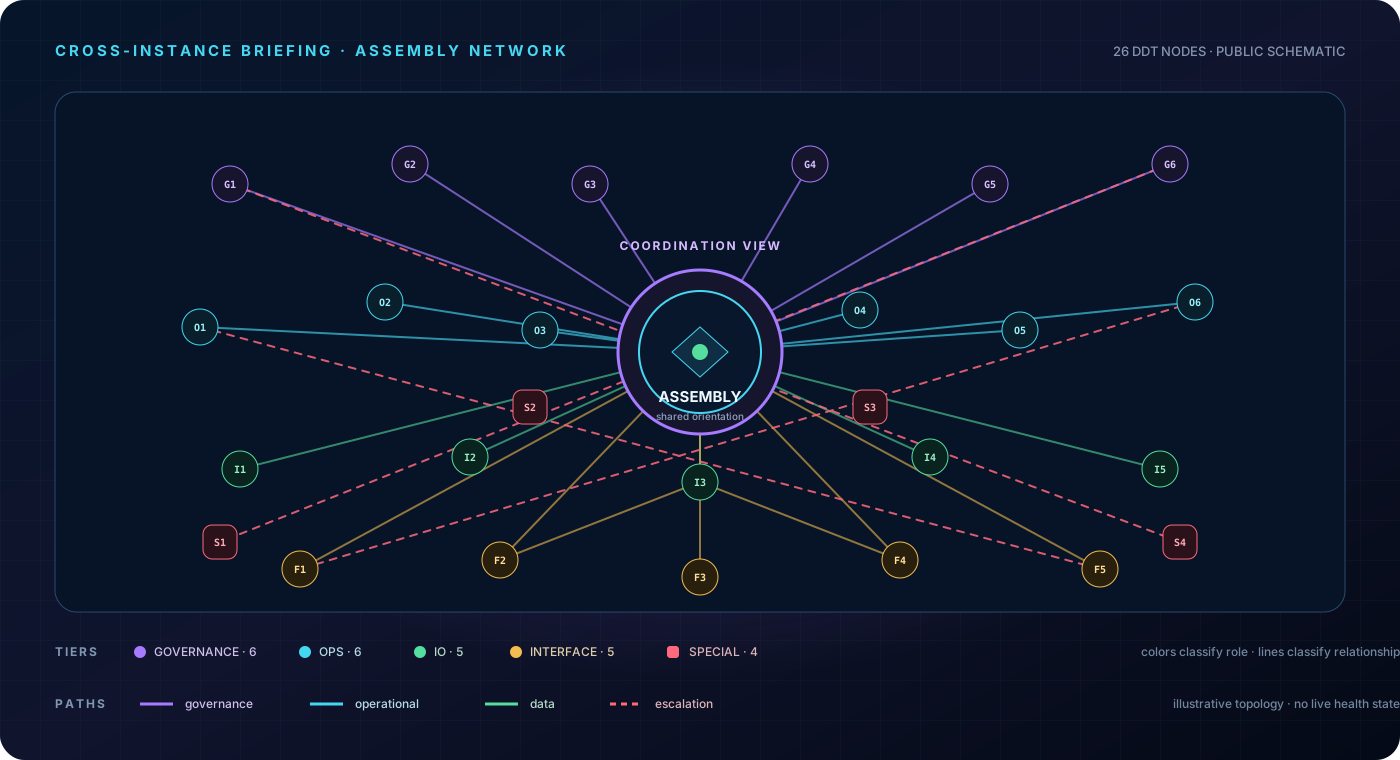
The Cross-Instance Briefing gives a new or returning assembly a bounded orientation to its neighbors: which roles exist, how they connect, what health signals matter, and where coordination must pause.
26DDT NODES ACROSS FIVE ROLE TIERS
▣
Public learning boundary. This diagram is an explanatory topology—not a live health monitor. It cannot discover private endpoints, route a task, notify an assembly, validate formation, change tier state, or prove that a downstream action occurred.
Public schematic of the briefing’s relationship model. Node labels are illustrative; current identities and health remain on the governed operator surface.
1. Follow the coordination sequence
A briefing gives the coordinator enough shared context to evaluate a cross-assembly operation. Select a stage to inspect its evidence and limit.
1
Health baseline · Read before coordinating
The coordinator begins with the governance state of each participating assembly: health classification, coordination readiness, and the nodes expected to take part.
Expected evidenceA per-assembly baseline tied to the coordination request.
Honest boundaryA visible assembly is not automatically healthy, compatible, or authorized for this operation.
2. Read the 26-node role map
Tier color answers “what role does this node play?” It does not substitute for node identity, current state, or a gate decision.
06
Governance
Constraint, oversight, and constitutional decision roles.
06
Operations
Execution, orchestration, and operator-facing roles.
05
IO
Controlled ingress, egress, and evidence movement.
05
Interface
Boundaries through which assemblies coordinate.
04
Special
Exceptional or escalated coordination functions.
3. Inspect the relationship types
An edge is not just a line. Its type tells the reader what may cross the relationship and what additional evidence is required.
4. Know what the briefing proves
It establishes shared orientation
The briefing names the assemblies, roles, typed dependencies, tier vocabulary, and evidence checkpoints needed to reason about coordinated work.
It does not complete the work
Reading or delivering a briefing is not routing, authorization, acknowledgement, execution, or a verified response. Those outcomes require their own governed evidence.
Continue the matched topic
Walk Assembly Coordination, or inspect the gated reference
The AIAGF walkthrough follows baseline, dependency detection, health propagation, and formation validation. The live OQS Protocol Library contains the governed Cross-Instance Briefing reference.