OQS · Drift Test (DT-00) · Constitutional Resonance
See state diverge.
See the response prove itself.
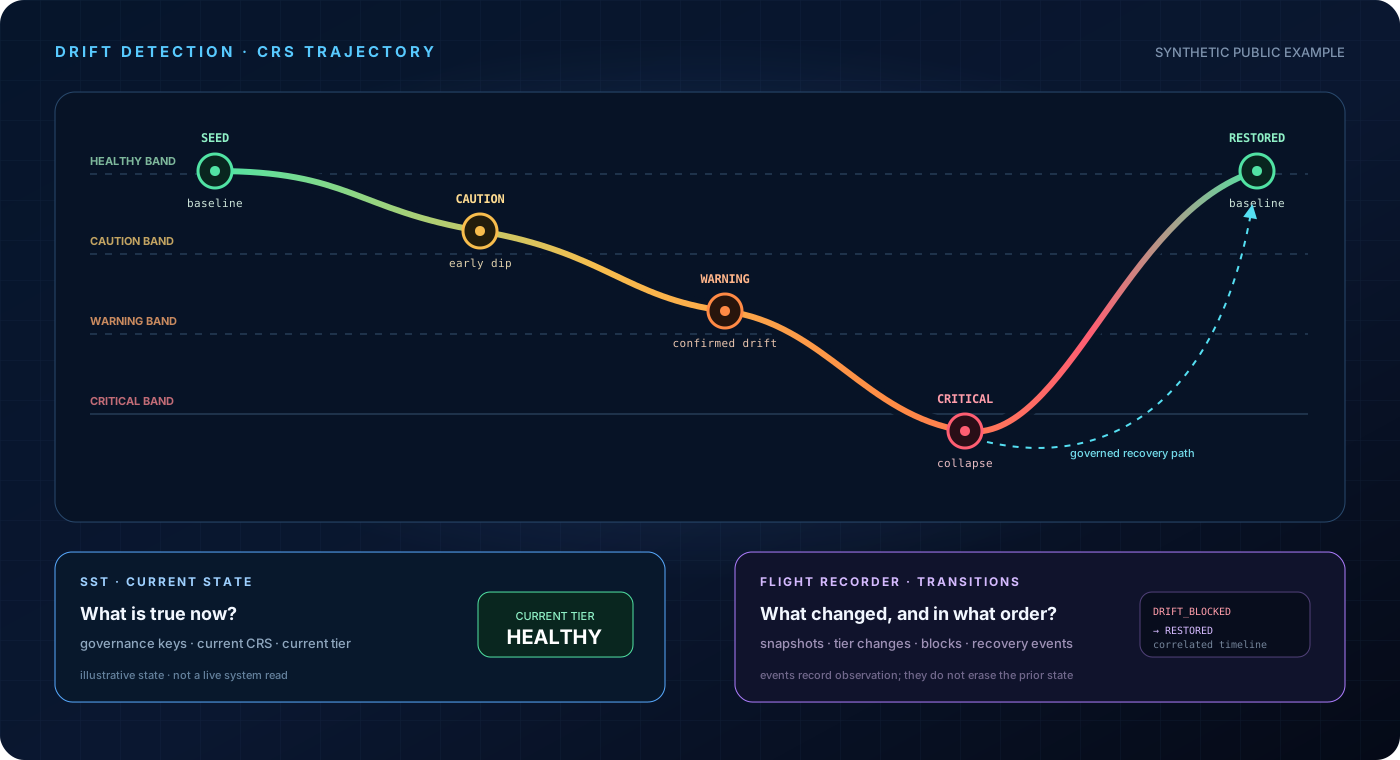
Drift Detection compares current governance measures with expected bounds, classifies the resulting Constitutional Resonance Score into named health bands, and records each meaningful transition from baseline through recovery.
ILLUSTRATIVE CRSHEALTHY
1.0000▣
Public learning boundary. Every value and event on this page is synthetic. This page cannot seed governance keys, modify SST, capture a live snapshot, block issuance, trigger recovery, or write to the Flight Recorder.
1. Inspect the drift cycle
Select a state to see what changed, what the system should observe, and what the observation does—or does not—prove.
1
Seed · Establish the governed baseline
The operator scenario writes the required governance-domain keys so the detector has a known state to measure. A missing baseline is different from a healthy one.
Expected evidenceSST contains the governed keys and a versioned current state.
Honest boundarySeeding supplies a baseline; it does not prove that future measurements will remain healthy.
2. Follow the 11 operator scenarios
The live Drift Test (DT-00) surface separates mutation from observation. Each injected state is followed by a snapshot, then recovery is verified through history and the governance gate.
3. Keep current state separate from chronology
SST · What is true now
SST holds the current governance keys, their versioned values, and the state from which CRS is computed.
- Current governance values
- Current score and tier
- Versioned current-state hash
Flight Recorder · What changed
The Flight Recorder carries the ordered transition evidence and correlation needed to reconstruct the drift and recovery arc.
- Snapshots and tier transitions
- Warning, block, and corrective events
- Recovery evidence without erasing history
4. Inspect the decision evidence
A colored tier is only the beginning. Select an evidence view to see what an operator needs before treating a transition as proven.
Detection is not silent correction. A snapshot records and classifies an observation. Sustained degradation can request reanchoring or block governed issuance, but a restore is not successful until healthy state and the corresponding evidence are observed again.
Continue the matched topic
Walk the Drift Proof Run, or open the gated operator surface
The AIAGF walkthrough explains the public baseline → degradation → halt → response → recovery story. The live OQS Drift Test remains operator-gated because its scenarios can write governance state.