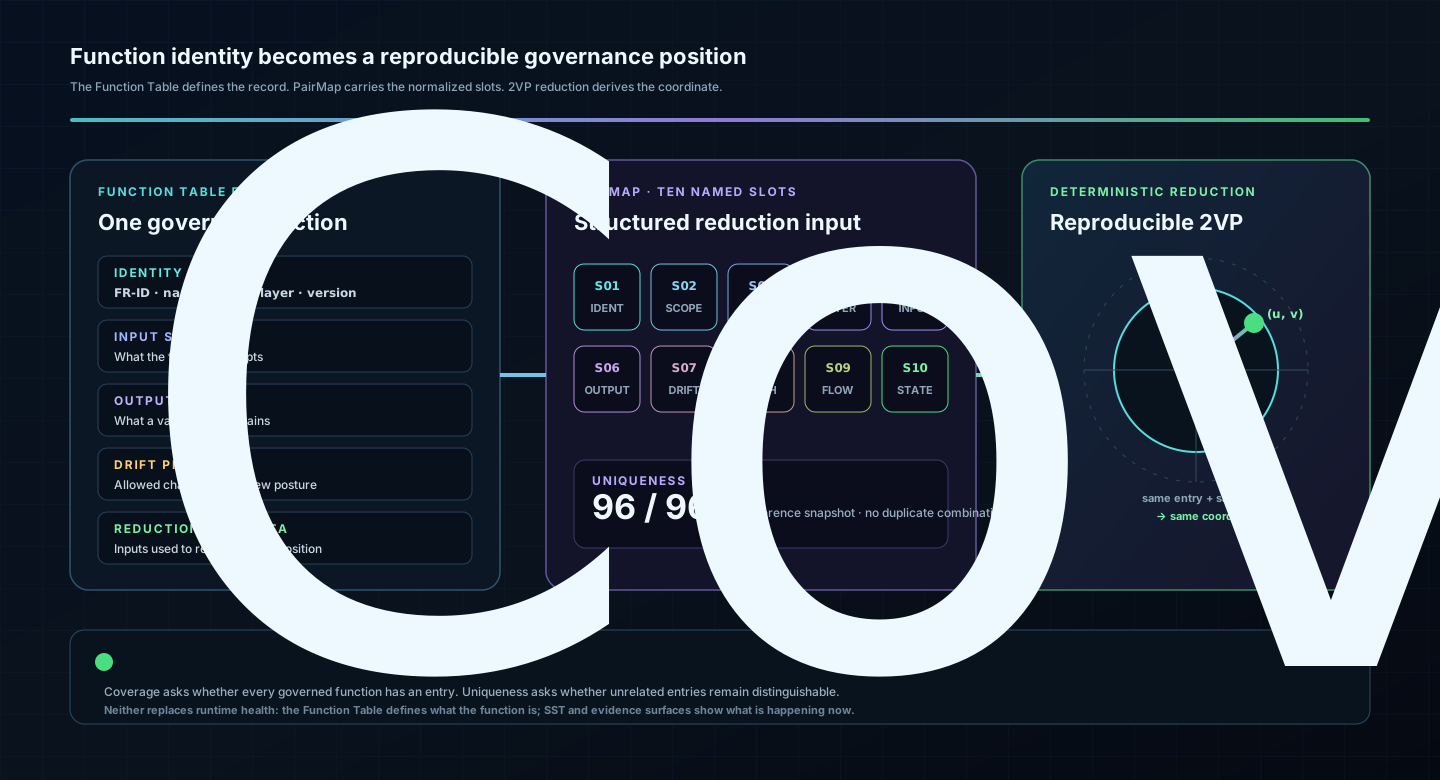
The Function Table defines what a governed function isA unique PairMap carries the entry into deterministic reduction so the same registered definition produces the same 2VP position.
Open Function Table walkthrough →Explore the anatomy of one entry
Click a field to see what it contributes. Function identity, interface contract, drift posture, and reduction metadata remain separate.
Read one synthetic entry
This example shows record shape only. The identifier and values are deliberately non-canonical.
- FR ID
- FT-SAMPLE-001
- FUNCTION ROLE
- Evaluate a bounded governance input
- INPUT
- { governance_snapshot, declared_scope }
- OUTPUT
- { verdict, reason, evidence_ref }
- DRIFT PROFILE
- Review when schema, authority, or output contract changes
- STATUS
- DESCRIPTIVE SAMPLE — not a registered function
SYNTHETIC RECORD · NO LIVE SOURCE CLAIM
PairMap gives reduction a stable input shape
Select any illustrative slot. Slot labels make the ten-part shape understandable; authoritative slot semantics must always be read from the current registered Function Table.
Coverage and uniqueness verify different properties
96 / 96Reference coverage: one Function Table entry per foundation FR-ID
96 / 96Reference uniqueness: each PairMap combination is distinguishable
0Reference duplicate count in the stated foundation snapshot
DOCUMENTED FOUNDATION SNAPSHOT · NOT A LIVE QUERY
Definition is not runtime health
The Function Table defines identity, schemas, PairMap, and drift posture. It does not prove that a function is healthy or that a historical count remains current. SST, execution evidence, and current registry checks answer those separate questions.