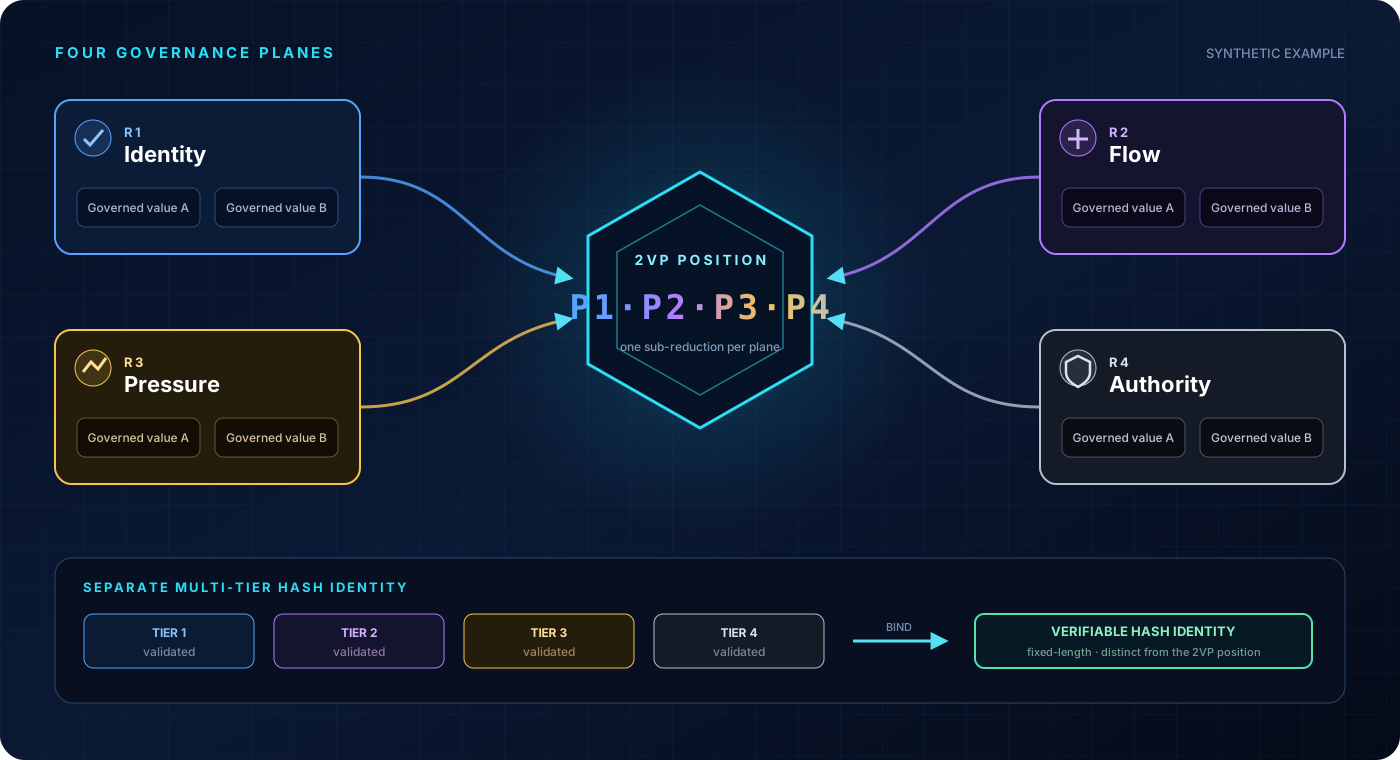
At every governed handoff, a Two-Value Pair (2VP) check uses a geometric reduction technique to turn a step's governed context into a reproducible classification and a multi-tier hash identity—without erasing where the signals came from. The next step can recompute both and verify it received what was intended.
▣
Public learning boundary. This page uses illustrative values and explains the observable structure only. It does not calculate a live identity, name or expose protected inputs, publish class boundaries, write state, or run the operator handoff check.
Illustrative public diagram. Values and labels are synthetic; the structure mirrors the governed handoff check.
1. Read the four planes
Each plane answers a different governance question about the step being handed off. Select a plane to see its role and why the separation matters.
1
Identity plane
Identity reduces a pair of governed values that describe what the step canonically is. It asks which registered structure the position represents.
What it capturesThe canonical structure the step claims to be
Why it stays separateA known identity must not be mistaken for healthy flow, safe pressure, or sufficient authority.
2. Pair the declared attributes
The consumer walkthrough shows a step's declared attributes. They enter the check as governed pairs—two values per plane, which is where the Two-Value Pair takes its name.
3. Route the step through a graded class
Each plane's deterministic weighted sub-reduction resolves into one of five graded classes. The class—not a guessed visual meaning—decides how the step is routed and how much scrutiny it receives at the next handoff.
4. Keep the two artifacts distinct
The handoff check produces two related outputs. They answer different questions and should never be collapsed into one.
GEOMETRIC POSITION
2VP classification
One deterministic sub-reduction per plane produces a compact, fixed-length position whose components each carry a graded class.
⟨Identity⟩ · ⟨Flow⟩ · ⟨Pressure⟩ · ⟨Authority⟩
≠
INTEGRITY ARTIFACT
Multi-tier hash identity
A four-tier hash structure binds validated tiers into one fixed-length identity that a later step can recompute and compare.
9f70…e2ad (illustrative)
Deterministic does not mean stored. The 2VP position is computed on demand from the step's current governed context. The same context and version reproduce the same position and the same hash identity, so the receiving step can verify the handoff instead of trusting it. The check itself does not invent randomness or persist the result.
Continue the matched topic
Walk the protocol, or return to the Porch
The consumer destination opens the dedicated three-step AIAGF 2VP walkthrough. The live OQS operator surface remains sign-in gated.