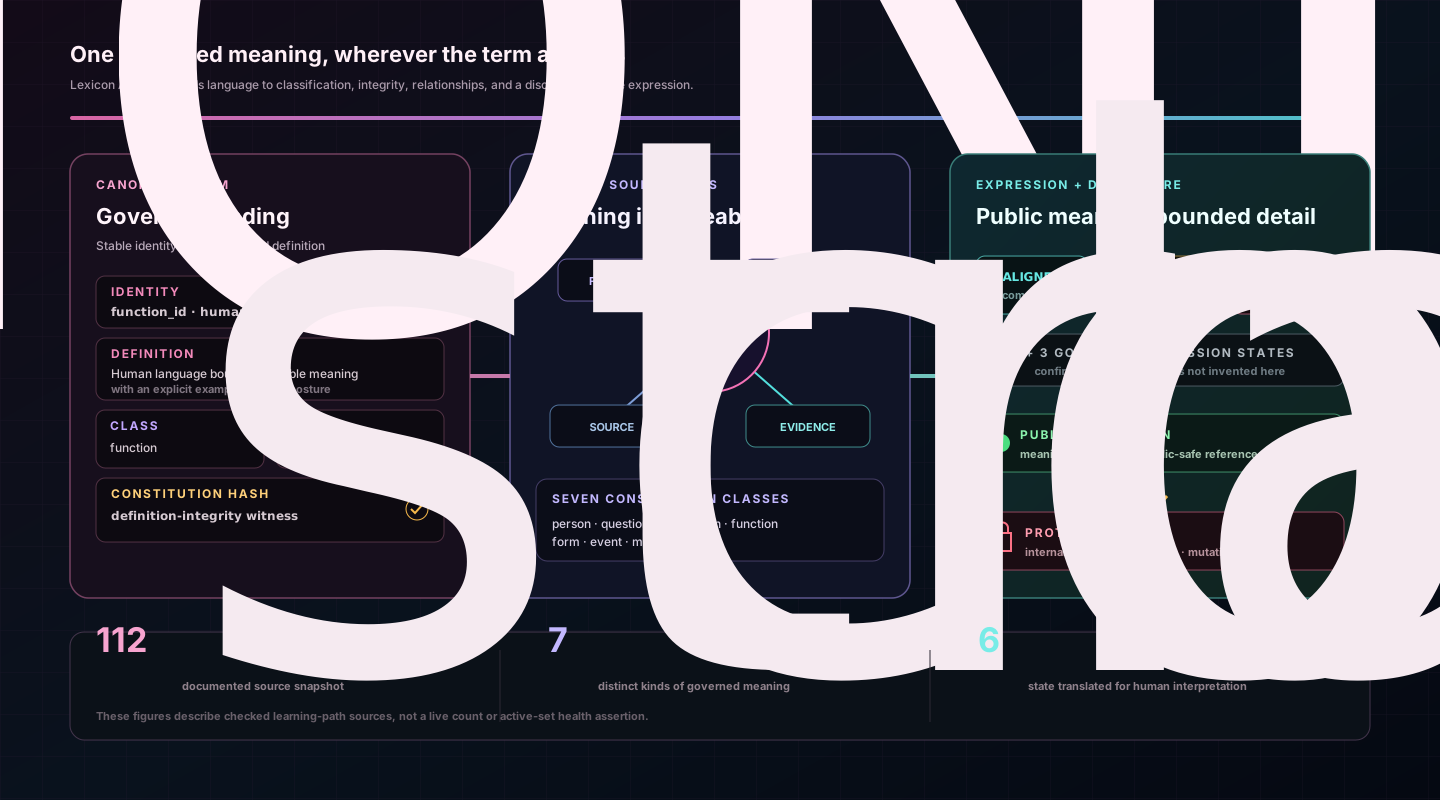
Lexicon Authority keeps meaning from driftingA named concept is bound to a governed definition and source context, then projected through a public disclosure boundary.
Open Lexicon Authority walkthrough →Read the anatomy of one governed term
Click a field to see how the operator surface binds human language to a stable constitutional record.
Seven constitution classes separate kinds of meaning
A term is classified before it is interpreted. Select a class to inspect its role.
Follow one descriptive example
The values below teach the record shape. They are not a live database row and the identifier is deliberately non-canonical.
- TERM ID
- lex-sample:governed-binding
- HUMAN NAME
- Governed binding
- DEFINITION
- A recorded link between a registry identity and the implementation it currently resolves to.
- CLASS / SCOPE
- function / entity
- SOURCE LINKS
- Function Registry · evidence record · governing protocol
- DISCLOSURE
- Public meaning is shown; protected mechanism detail is withheld.
DESCRIPTIVE SAMPLE · NO LIVE ROW OR HASH CLAIM
Base expressions communicate governed state
The current source names three of the six seeded states. The other three are shown honestly as governed extensions rather than invented labels.
The documented reference describes structure, not live health
112Strategic glossary terms in the source snapshot
7Lexicon constitution classes on the OQS operator surface
6Seeded base-expression states referenced by the learning path
DOCUMENTED SOURCE SNAPSHOT · NOT A LIVE QUERY
Public meaning does not require public mechanism detail
PUBLIC EXPRESSION
Names the concept, explains why it matters, and links to public-safe governed references.
DISCLOSURE
GATE
GATE
PROTECTED DETAIL
Internal-only terms, sensitive mechanism detail, mutation controls, and operator evidence stay behind the signed-in surface.