How a Request Becomes Governed Work
How a Request Becomes Governed Work
A prompt can start a conversation. Governed work needs a record of what was requested, who owns it, and what must be true before it moves.
Our workday usually starts with a meeting.
First thing in the morning, we talk through what needs attention and delegate the day’s tasks. Some items are small enough to handle in a conversation. Others will cross projects, involve several agents, require evidence, or create decisions that matter beyond the person doing the immediate work.
Those two kinds of work should not enter the system in the same way.
If we want a quick explanation or a rough idea, an ordinary prompt may be enough. We ask a question, consider the answer, and move on. Formal structure would add more weight than the moment needs.
But when an idea is supposed to become build work, coordinated investigation, or a lasting change, we use a SPOC form.
SPOC is a Qensai product term; we do not ask a newcomer to know what the letters stand for. The useful definition is simpler: a SPOC form is Qensai’s governed intake form. It is the start-here brief that turns an idea or request into something traceable and reviewable before consequential work begins.
An ordinary prompt asks for an answer. A SPOC creates a work item.
The form gives the request a topic, context, constraints, and an intended direction. It can preserve what the requester is trying to accomplish, what is already known, what remains open, and what kind of result is expected. That structure gives the system—and the people responsible for it—something more dependable than a message floating in a conversation.
From there, the draft can enter the 2VP Workbench.
The name is specialized, but the basic function is approachable. The Workbench is where the request can be reviewed, graded, connected to related work, and routed toward a decision or next action. It helps turn “please do this” into “this is the work, these are its boundaries, and this is how we will know what happened.”
The canvas is the working surface around that request.
We use a canvas as several things at once: a workspace, a notepad, an evidence map, a project board, and shared memory. It can show the request beside its tasks, sources, decisions, open questions, related canvases, and eventual result. A person can return later and see more than the final answer. They can see how the work was shaped.

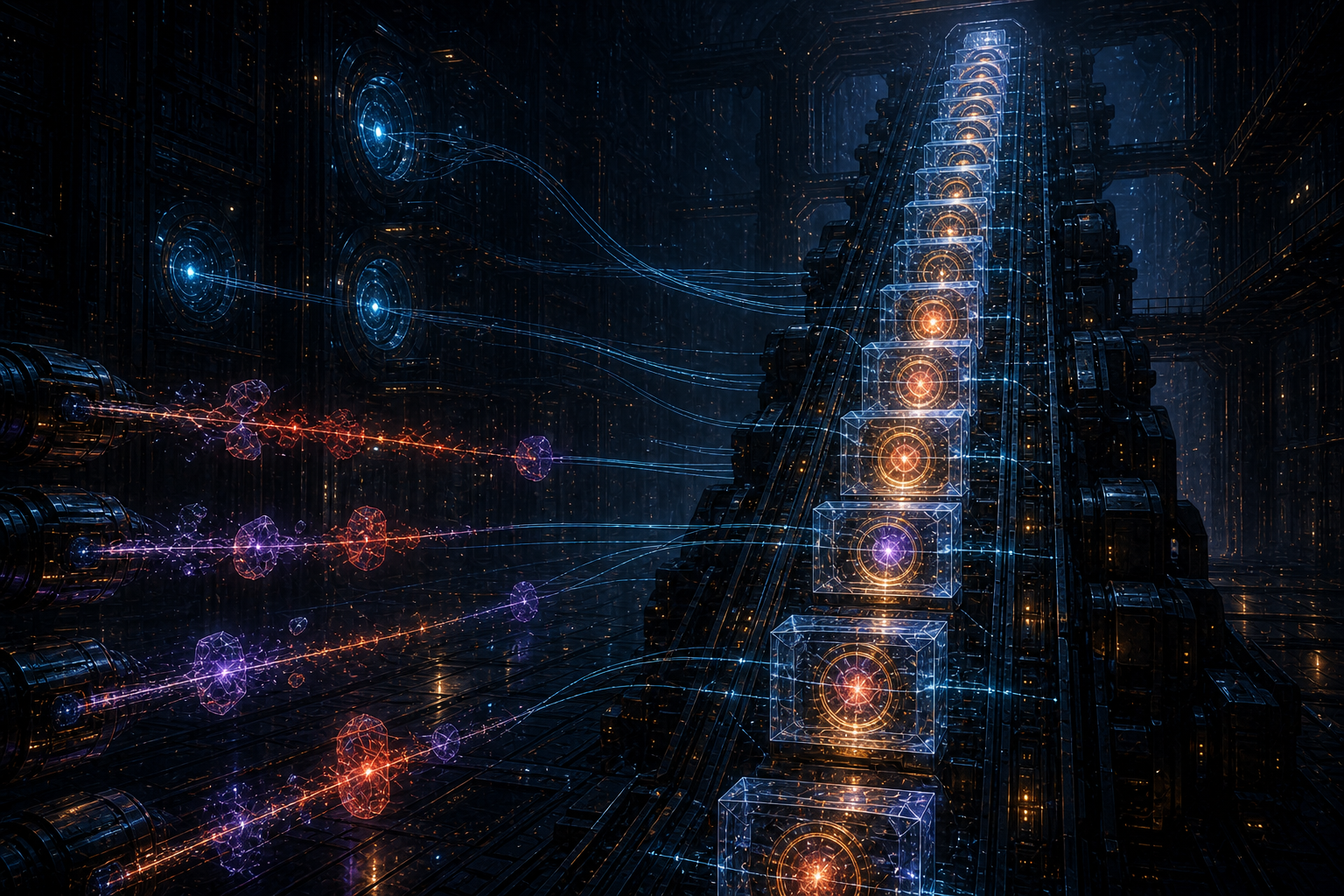
From the original series artwork — explore the series.
Not every conversation needs this machinery.
Qensai also has room for freeform notes and lightweight exploration. The formal path is for work that needs governance, grading, routing, traceability, or durable artifacts. The distinction keeps casual thinking easy without letting consequential work disappear into casual chat.
Once the request is structured, routing does not always require a person to approve every handoff.
A bot may delegate or forward work under rules that have already been established. Some paths run in sequence or in parallel. Other paths are supervised and pause before the next agent receives the work. A human or pickup step can be required when the route, risk, or decision demands it.
This is an important balance. Requiring a fresh human click for every harmless step would make the system slower without making it wiser. Allowing every bot to choose its own authority would make the system fast in the wrong way. Governed routing lets automation move inside defined boundaries while preserving places where a human must decide.
The same principle applies when information is missing.
The system should not quietly guess and continue as though nothing happened. Depending on the situation, it can ask for missing inputs, return a structured partial answer, hold the work until prerequisites exist, block an unsafe action, route the question elsewhere, or require human review.
Different situations call for different responses, but they share one principle: missing evidence changes what the system is allowed to claim or do.
That is also why an answer is not always completion.
For casual chat, an answer may be the whole point. For governed execution, completion includes the answer or action, the evidence supporting it, the state of verification, any remaining open items, and a recorded outcome. The work needs to leave behind enough context for another person or agent to understand what was requested and what actually occurred.
The result is not a system in which bots can never move without us. It is a system in which their movement has a route, a record, and a boundary.
Once the request has entered that structure, the next question becomes unavoidable: a system may be capable of taking an action, but what gives it the authority to do so?

One character flips ALLOW to BLOCK
A recorded evaluation run reproduced our composite hash math offline, watched a correct vector route ALLOW through twelve checkpoints, then watched a mismatched composite and a malformed tier both die as isolation faults. Governance by arithmetic: the router cannot be argued with, because it is a hash.
The witness ledger: failure is audited
In a recorded evaluation run, failed boots, failed approvals and blocked validations all landed in the append-only Flight Recorder as correlated event chains - and a cross-tab action appeared in the ledger eight seconds after the click. The strongest proof of an audit spine is what it records when things go wrong.

A node becomes a post, under governance the whole way
The complete walk of one idea from a canvas node to a published article: a staged request, a governed topic, a machine-minted draft, and a readiness gate that says no until the record is right. Every hop is traceable in both directions, and the refusals along the way are the point.
Stay Updated
Get notified when we publish new research or open licensing opportunities.
Owner-gated agent operations. Every action behind your flip.
See the platform →
0 comments