Temporal Cohesion Architecture: When Trust Becomes a Property of the System
Q-En-S-Ai’s Temporal Cohesion Architecture—TCA-JBD—approaches the problem differently. It treats trust as a living relationship among system state, observed behavior, independent governance authorities, and machine-native temporal variation.
The result is infrastructure designed to remain coherent as it changes.
Identity derived from living state
In TCA-JBD, an assembly’s identity is not merely a static identifier stored in a registry. Identity is continuously associated with the assembly’s current state, behavior, governance context, and temporal environment.
This makes identity harder to separate from the real system producing it. A copied credential or imitated message is insufficient because authority depends on whether the assembly remains coherent with the system’s evolving truth.
Jitter-Bug Depolarization
At the center of the architecture is Jitter-Bug Depolarization, or JBD.
Real machines never operate with perfectly uniform timing. Runtime scheduling, system pressure, hardware behavior, and execution conditions create small variations in the system’s rhythm. JBD incorporates these irregularities into a changing Temporal Entropy Field.
The field is not used alone. Two independent governance authorities—BDD and Operator—contribute separate, protected transformations. Neither authority possesses the complete basis for authorization independently.
This creates a dual-authority identity signal that evolves with the system and cannot be reconstructed from one governance channel alone.
The public architectural principle is simple:
Identity is bound to state, behavior, and temporal context—not merely possession of a credential.
The underlying mixing process, salts, thresholds, and construction details remain intentionally undisclosed.
The System State Table
The System State Table, or SST, anchors the architecture’s operational truth.
It records the governed state against which assemblies, permissions, and proposed actions are evaluated. Material state transitions require independent validation from both governance authorities.
An assembly may act only while its claimed state remains coherent with the SST. Authorization is therefore contextual rather than permanent.
This changes the meaning of an execution token. Instead of remaining valid until an arbitrary timeout expires, a token remains usable only while the conditions supporting its issuance remain true. If the system drifts beyond its governed coherence boundary, authorization is invalidated.
Drift becomes a security signal
Conventional systems often discover drift after an incident, audit, or failed deployment. TCA-JBD treats drift itself as an actionable signal.
When an assembly’s observed behavior, identity, or state no longer agrees with the governed system state, the architecture can constrain execution and initiate a health assessment through SysSecureOps.
Depending on the character of the mismatch, the response can include:
automatic authorization revocation;
isolation or quarantine;
cross-checking journals and watcher evidence;
an assembly identity challenge;
escalation for dual-authority review; or
an imposter alert when behavior indicates attempted impersonation.
The objective is not to predict every possible failure. It is to make incoherence difficult to hide.
Five properties of temporal cohesion
TCA-JBD is designed around five mutually reinforcing properties.
Self-coherent
State changes remain bound to governed system truth. An assembly cannot silently redefine its own authority.
Self-verifying
Independent journals, watchers, state records, and execution evidence cross-check one another. Claims are evaluated against observable outcomes.
Self-defending
Material drift constrains execution. Identity mismatch produces isolation and investigation rather than continued operation under stale trust.
Self-regulating
Independent governance authorities prevent unilateral promotion of consequential changes. The producer of an action cannot alone authorize that action.
Temporally bound
Identity and authorization incorporate the changing rhythm of the real system. Trust is valid only while the context supporting it remains coherent.
From distributed software to computational organism
Most distributed systems are assembled from static identities and externally imposed controls. Their components may continue operating even after the assumptions supporting their authority have decayed.
Temporal Cohesion Architecture introduces a different model: a distributed system that continuously compares what it is doing, what it claims to be, and what its governed state says should be true.
That does not make the system infallible. It makes integrity an active process rather than a configuration established once and assumed forever.
TCA-JBD transforms distributed AI assemblies from collections of credentialed services into resilient computational organisms—capable of preserving identity, authority, and trust under load, mutation, and adversarial pressure.
The central idea is straightforward:
A trustworthy system should not merely remember that an action was authorized. It should continuously prove that the action still belongs to the system performing it.
Reading the Verdict
How to read a Forge result like the system does: the five governance domains and the failure each one catches, the seven weighted dimensions inside the Confidence Score, and what to do at each band.
The Transverse of Intent
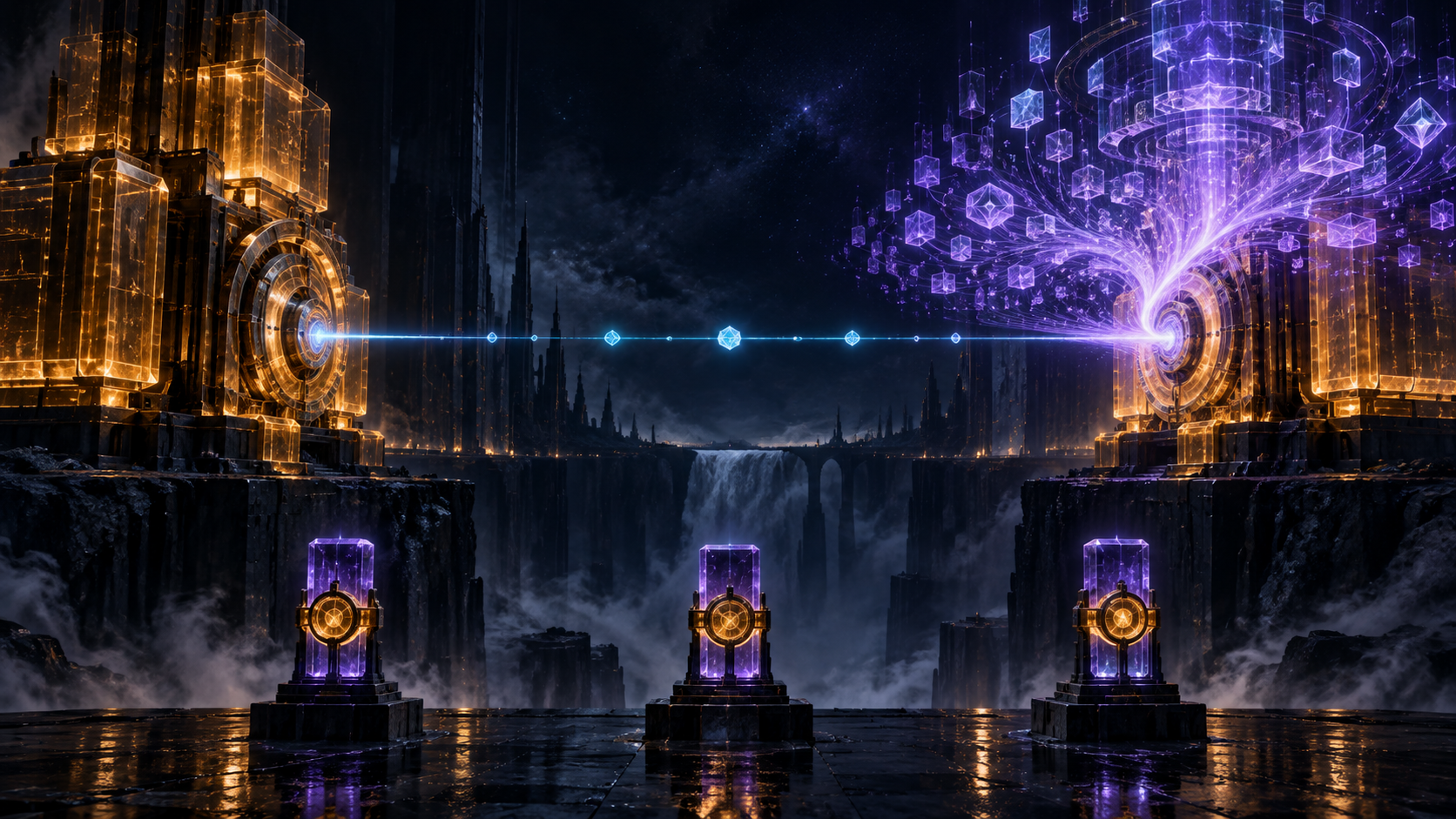
When the constitution is known by all involved, only the transverse of intent need be shared. Less data crosses the wire while more meaning is derived, at a cheaper compute cost. Its dual: independence is what lets a single bit stand for the whole.
Origin Evidence: The Decision Rail Failure
Why This Record Exists: This incident captures one of the recurring failure modes that motivated the construction of QENSAI and its governed operating architecture.
Stay Updated
Get notified when we publish new research or open licensing opportunities.
Owner-gated agent operations. Every action behind your flip.
See the platform →
0 comments