Turning the Mistake Into a Trap
Once we removed a persistent signature from the authority path, we had a choice: delete every trace of the old mechanism, or keep part of it as an observation point.
The second option is more interesting, but it is also easier to overstate.
We have not built a production deception corridor and proven it safe. What we have is a design direction that came out of a real boundary mistake: an artifact can look like authority without being capable of moving protected state.
If that separation is enforced, attempted use of the artifact may tell us something useful.
Why keep a failed mechanism?
The original persistent signature was a problem because it had become part of the decision to issue one-time crossing authority. After separating those responsibilities, the signature no longer needed to grant anything.
But it still looked meaningful from the outside.
Someone—or some stale integration—might continue presenting it because they expect the old path to work. If the system simply returns a generic denial, we learn very little. If the attempt can be observed safely, it may reveal an outdated client, a misunderstood integration, or deliberate probing.
Those possibilities are not equivalent. One failed presentation is not evidence of an attacker. Any useful design must preserve that uncertainty.
Appearance and authority must be separate
The core safety rule is simple: the artifact being observed cannot be the thing that authorizes a real transition.
The visible mechanism may resemble a standing credential. The actual gate still requires current, one-time authority derived from the live crossing. Presenting the old artifact must never satisfy that requirement, modify protected state, or reveal the material used by the real path.
If we cannot maintain that separation, there is no trap—only another authentication surface with an alarming name.
This is why the one-time model matters. Real authority is short-lived and tied to current state. The observable artifact can remain stable enough to collect repeated attempts precisely because it grants nothing.
What a governed corridor would require
A useful deception corridor needs more than a decoy response. It needs explicit limits that can be tested and reviewed.
At minimum, we would define:
- Entry conditions: the exact presentations or behaviors that route an event into observation.
- Isolation: the systems and state that the corridor can never change.
- Telemetry: what is recorded, for how long, and for what purpose.
- Containment: the resources and interactions available inside the corridor.
- Exit conditions: when the interaction stops or is escalated to an operator.
- Review: who can examine the evidence and how false positives are handled.
The corridor should not become a second route into production. Any state used for interaction should be synthetic, isolated, or tightly bounded. Responses should avoid exposing live topology, thresholds, timing rules, or the inputs used by real crossing authority.
Observation is not attribution
The system also has to resist the temptation to label every presentation as hostile.
A stale SDK may repeat an old signature. A test environment may point at the wrong endpoint. An operator may follow outdated documentation. Those cases can look similar to early reconnaissance.
We would treat a single event as telemetry, not a verdict. Repetition, variation, scope changes, timing, and surrounding context may justify escalation, but that classification belongs in the monitoring and governance layer—not in the authority decision itself.
That separation protects both sides. The gate remains deterministic about what may move state, while the monitoring system can reason more cautiously about why someone tried the wrong path.
The risks are real
Deception systems create their own attack surface. They can collect sensitive data, consume resources, confuse incident response, or drift until they interact with production in ways nobody intended.
They can also encourage clever storytelling before the engineering is finished.
For this idea to advance beyond a design, we would need isolation tests, evidence-handling rules, resource limits, failure behavior, and a clear shutdown path. We would also need to demonstrate that no response from the corridor can be replayed against the real gate.
Until then, “measured deception corridor” describes the direction of the work, not a deployed security capability.
What the mistake taught us
The original problem came from collapsing three different ideas:
- Who is making the request?
- Has this machine been admitted?
- Is this one transition authorized under current state?
Separating them made the gate easier to reason about. The possible corridor adds one more separation:
- What looks like authority?
- What can actually exercise authority?
That last boundary turns the old artifact from a liability into a potential signal—but only if the isolation is real.
The lesson is less dramatic than “we turned an attacker’s tool against them.” We found a control in the wrong place, removed its power, and noticed that attempts to use the old path might be worth measuring. The hard part is proving that measurement cannot steer the protected system.

A node becomes a post, under governance the whole way
The complete walk of one idea from a canvas node to a published article: a staged request, a governed topic, a machine-minted draft, and a readiness gate that says no until the record is right. Every hop is traceable in both directions, and the refusals along the way are the point.

The Organization Was Doing the Work. It Just Couldn’t Hear Itself.
Work can succeed locally while remaining invisible to the organization. The missing piece was not more activity—it was evidence that the rest of the system could receive and understand what happened.
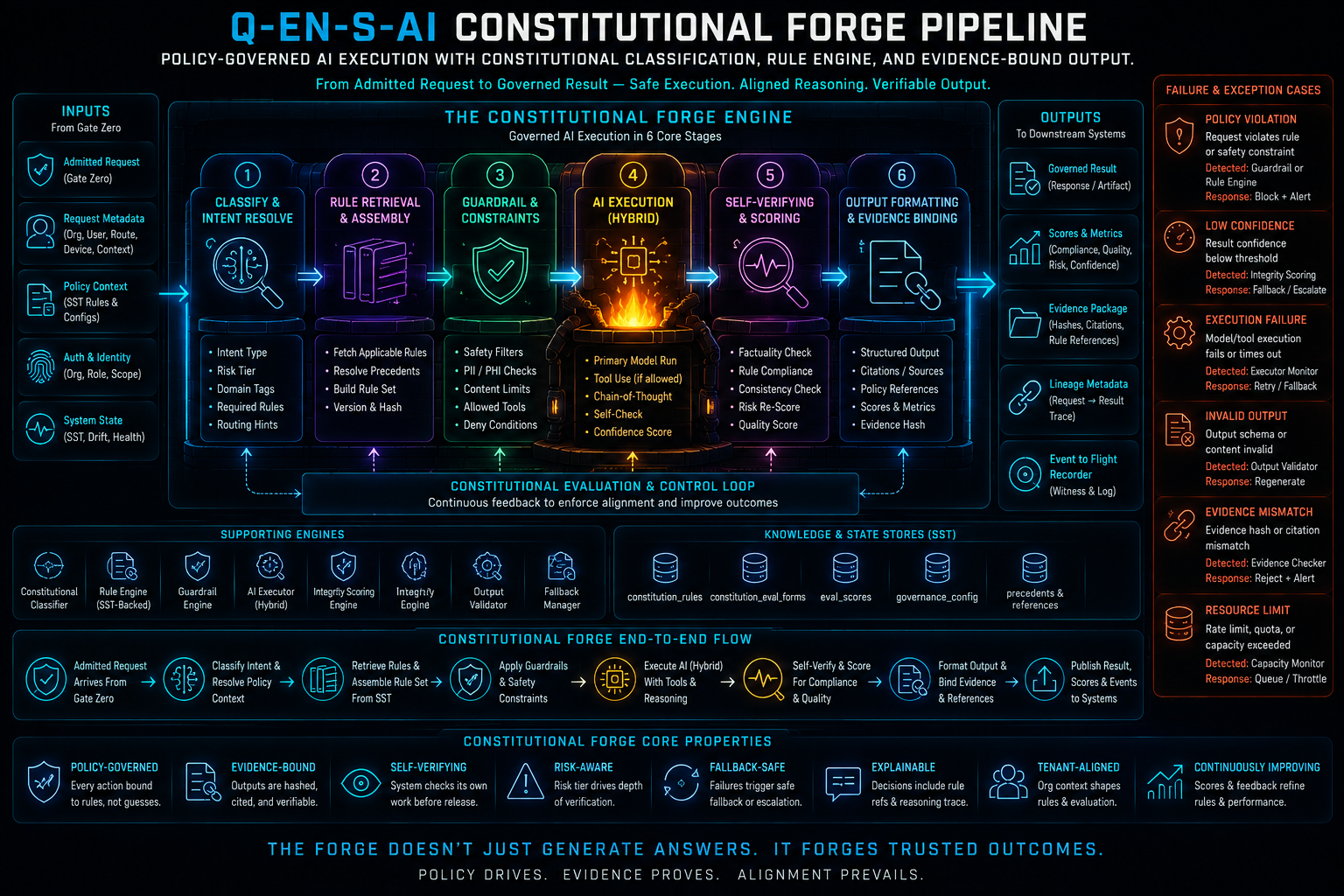
From capture to publication
A signal is not a post. The review chain that turns one into the other.
Stay Updated
Get notified when we publish new research or open licensing opportunities.
Owner-gated agent operations. Every action behind your flip.
See the platform →
0 comments