The strongest part of the incident was not that an agent detected duplicated work.
It was what it didn't do afterward.
It didn't silently merge the systems.
It didn't rewrite somebody else's architecture.
It didn't claim authority over the other effort.
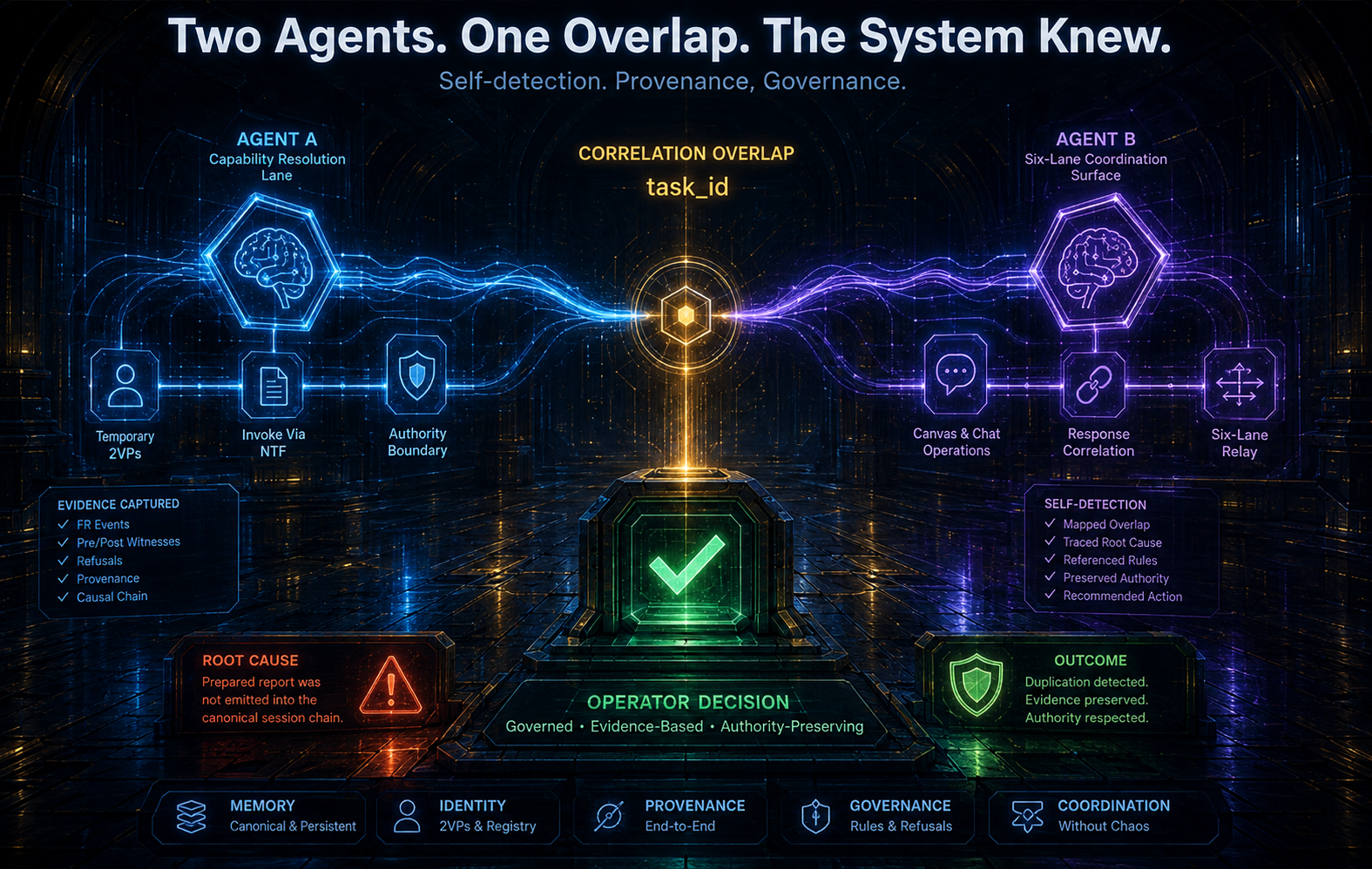
It laid out the evidence, identified the conflict, and asked the operator to rule on the areas requiring authority.
At one point the agent considered whether the converging work justified a new shared SPOC.
The mechanism for creating one already existed.
But the agent explicitly stopped:
“I am not filing it.”
The mechanism was available.
The authority was not.
That distinction is central to what I am trying to build.
The real goal
I am not trying to create agents that never make mistakes.
That is unrealistic.
I am trying to build infrastructure where mistakes, collisions, missing evidence, and authority problems have difficulty remaining invisible.
There is an enormous difference between:
an agent making a mistake
and
a system being unable to reconstruct how that mistake happened.
This incident gave us something worth investigating further.
Not proof that the architecture is finished.
Not proof that autonomous governance has been solved.
But real evidence that the system is beginning to observe its own coordination failures.
And the next discovery made the incident even more interesting.
The system pieces in this story
Every term below is a working part of Q-En-S-Ai. Each links to its entry in the live Governance Glossary, where you can follow it into the running system (sign-in required).
Capability-resolution lane — the governed path that resolves a request to an exact, registered function identity before anything is allowed to run. Nothing executes by name-guessing.
Correlation envelope — the metadata wrapper that ties an event to the work it belongs to — the task, the request, the thread it answers, the assembly that responded, and a dedupe key — so evidence about the same work can be joined back together later.
task_id — the join field both designs converged on: the identifier every piece of evidence about one unit of work carries.
SPOC — the system's oversight record for a topic of work. The record exists before execution, carries the rules that govern the work and the identities it touches, and is graded by the operator. Creating one is itself a governed act — which is why the agent stopped at the threshold.
Canonical session chain — the shared, append-only ledger of session reports (the system's Session Journal) that agents rely on to discover each other's completed work. Work that never enters it is, for practical purposes, invisible.
Reconciliation report — the evidence-first writeup an agent produces when new work collides with existing state: the comparison, the likely cause, and the decision handed back to the operator.
Next in this series: The Bug Wasn't Coordination — It Was Emission


0 comments