The request that asked for the demo became the demo.
On October 23, an operator commented on a social post about the agent era and asked for a visual-governance presentation showing where this system fits. The second part of the request mattered just as much: raise the request as a governed topic so the presentation could show its own journey through the system.
That made one request both the commission and the subject.
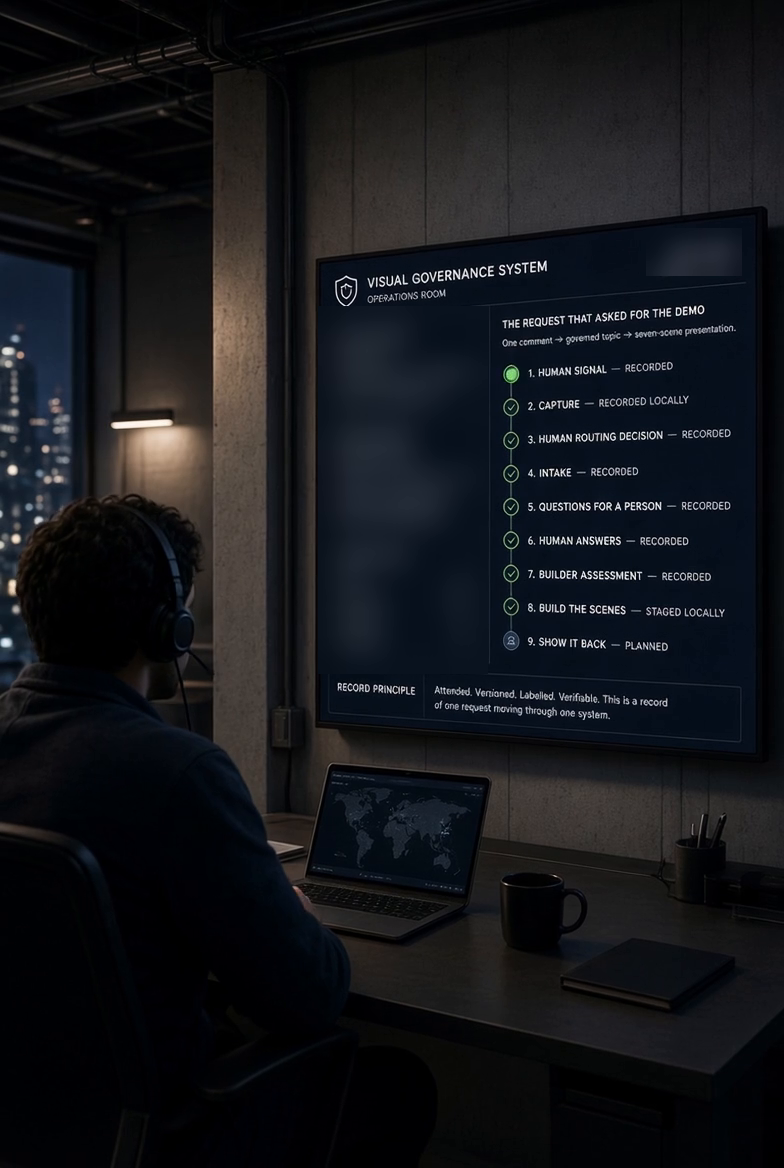
The lifecycle, stage by stage
- Human signal — recorded. The operator asked for a visual presentation that connected a set of external ideas to real, inspectable system tools. The external ideas were treated as context, not as evidence about this system.
- Capture — recorded locally. A capture role saved the comment and six supplied slides with fingerprints, then wrote a scene plan. Each proposed connection was labelled strong, partial, context only, or excluded.
- Human routing decision — recorded. The operator reviewed the intake and chose to place it under an existing presentation topic instead of creating a separate parent topic.
- Intake — recorded. The intake coordinator checked 776 existing topic forms and 33 topics and found no duplicate. The request then passed through the system's front door, which created a child topic, a working canvas, and a decision table.
- Questions for a person — recorded. Four decisions were placed on the table: which ideas and tools to use, where the presentation should live, what could be public, and how much evidence detail each audience could see.
- Human answers — recorded. An AI role drafted recommended answers. A person accepted them as written, and all four were posted as the operator's decisions.
- Builder assessment — recorded. The presentation team read those decisions and staged a bounded implementation plan inside the existing interactive presentation system.
- Build the scenes — staged locally. Under a separate local-only authorization, the team built a seven-scene presentation in the existing shell. Static checks and desktop and phone browser checks passed.
- Show it back — planned. The attended accuracy walk, signed-in evidence review, commit, release synchronization, push, deployment, and hosted acceptance remain separate future steps.
What the system decided
The presentation leads with the governed harness around an agent: connectors, evaluations, rules for what an agent may touch, and a human review screen. It then shows identity and access, the Flight Recorder as an evidence chain, governed memory and lineage, a person answering when an agent is stuck, and software shaped around the work through the visual workspace and Prompt Forge.
Ideas without a real feature behind them were left out. The claim that a model can be swapped while governance stays unchanged is being held until a recorded two-model run proves it.
The scenes live inside the existing interactive presentation shell. The team did not create a separate site or copy the shell.
The public version can show the lifecycle as labelled stages, dates, evidence labels, statuses, and aggregate counts. The original comment screenshot, the six external slides, full identifiers, decision rows, and detailed event payloads remain in an attended view.
What the record exposed
The first capture handoff did not move to the intake coordinator on its own. A coordinator moved it by hand. Automatic routing between roles is still not fully reliable.
One assessment document also changed after it was sent. The current revision, rather than the message-time copy, is the one linked from the governed topic. That is a small detail with a large consequence: the record has to say which version it means.
The first authorization covered submission and staging. A later, separate decision allowed local implementation and testing. The resulting scenes are real local work, but they are not a deployed product claim. They remain uncommitted, unpushed, and unaccepted in the hosted environment.
Explore the public surfaces
This is a record of one attended request moving through one system. A person chose the route, accepted the answers, and separately authorized the local build. The remaining stages stay labelled planned until their own durable evidence exists.

0 comments