Until early October, running the system meant keeping a window open for every specialist agent. A question placed on the Response Table, the shared board where the operator asks and the seats answer, only reached a seat if someone opened that seat's window and told it to look. Six seats meant six windows, and a question could sit unanswered simply because nobody was watching the right one.
The goal is one desk. The operator asks from one place, the right seats answer, and the answers come back on the record, all without sitting at each window waiting.
How a question travels now
- The operator sends it. From the Response Table, the operator saves a question and chooses which seats receive it. The send is signed in as the owner, and the choice of recipients applies to that send only.
- It lands in the seat's inbox. Delivery drops the request into the seat's inbox, and the system notes that it has arrived.
- A person arms it. Before anything runs, someone arms the request once. Arming is a readiness check: it confirms the request is well formed and the seat is ready, without running a model or producing an answer. Arrival alone never starts work.
- It runs once. When a request has both arrived and been armed within ten minutes of each other, in either order, the system dispatches it exactly once.
- The seat answers as itself. The seat's own worker writes the answer. The system checks that the reply came from that seat's own outbox before posting it back onto the question's row.
The trial
This was tried once for each of three seats: the operations seat, the blog seat and the evaluation seat. Each trial question asked the seat to confirm, in one sentence, that it had received the request this way.
All three answered on the board. In the operations seat's trial the answer was posted about twenty seconds after the request was armed; the other two were similar. None of the seat windows was opened.
The answers were also candid about their own limits. Each seat confirmed receipt, then added that it could not independently verify the pickup mechanism that had delivered the question. That is the right answer: a seat can say what it received, not how the plumbing works.
Which seats can receive questions this way is a single setting per seat. Adding a seat is a configuration change, not new code.
What went wrong on the way
Two faults turned up while this was being built, and both were fixed:
- The first version only worked when a request was armed before it arrived. A request that arrived first and was armed afterwards was never dispatched. It now works in either order.
- The part of the system that sends questions read its own settings with a separate, simpler reader that ignored the new per-seat setting, so a newly enabled seat was not recognized as a recipient. That reader now picks up the setting, and its test runs against the real configuration.
One known problem is still open. A background checker logs an error each time a reply file appears, because it expects a kind of content that replies don't carry. It does not stop replies from being recorded.
What this is, and what it is not
This is one live trial per seat, on one workstation, for three seats. The other seats still work the old way.
"Without watching windows" does not mean autonomous. A person still sends every question and arms every request; that step is the human in the loop, and it is there by design. The answers are read-only. Nothing that changes code, deploys software or alters the operating rules goes through this path.
What changes is where the operator's attention goes. Instead of keeping watch over several agents, the operator works from one desk. Questions reach the specialist seats, and their answers come back on the record where they can be checked.
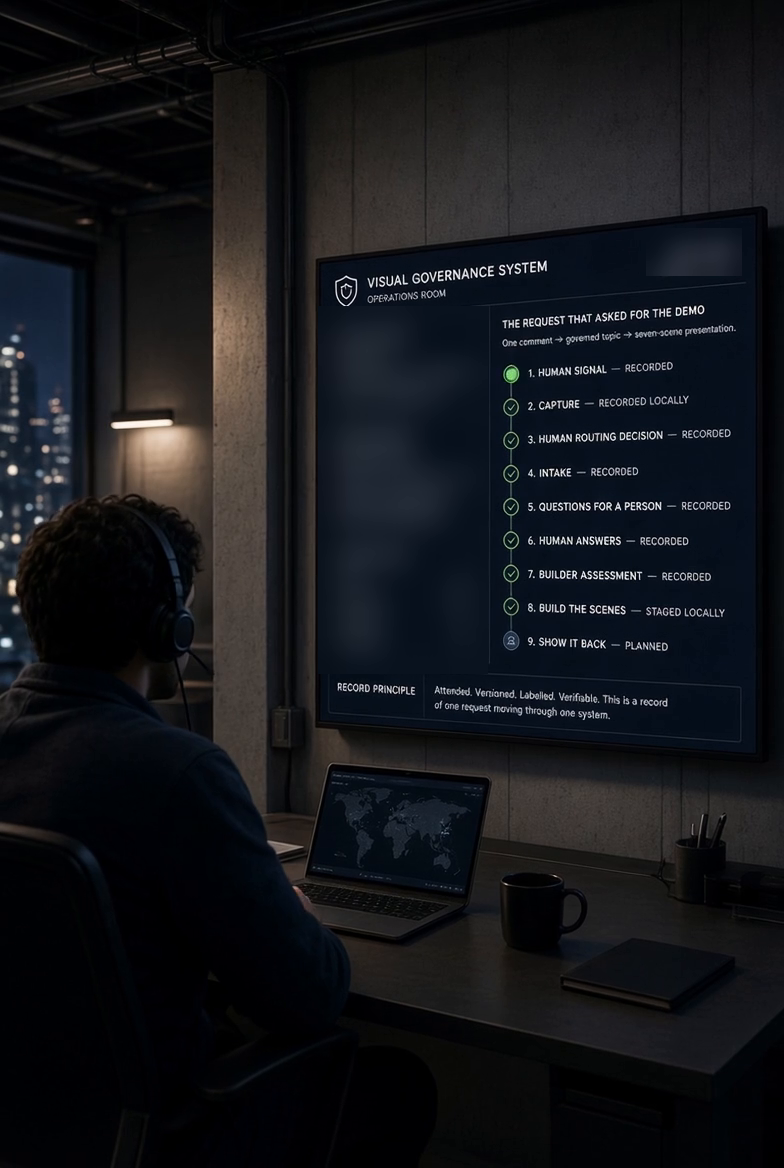
Where this sits in one request: One Request, Governed — the Response Table


0 comments