Aug 28, 2026
File Genesis Protocol
A file is not born governed. It is hash-stamped at birth, compared against everything that came before it, and earns canonical status only through a three-verifier gate.
Qensai•5 min read
Sharp, practical notes from the people building owner-gated agent systems.
A file is not born governed. It is hash-stamped at birth, compared against everything that came before it, and earns canonical status only through a three-verifier gate.

A recorded evaluation run reproduced our composite hash math offline, watched a correct vector route ALLOW through twelve checkpoints, then watched a mismatched composite and a malformed tier both die as isolation faults. Governance by arithmetic: the router cannot be argued with, because it is a hash.

In a recorded evaluation run, failed boots, failed approvals and blocked validations all landed in the append-only Flight Recorder as correlated event chains - and a cross-tab action appeared in the ledger eight seconds after the click. The strongest proof of an audit spine is what it records when things go wrong.

The complete walk of one idea from a canvas node to a published article: a staged request, a governed topic, a machine-minted draft, and a readiness gate that says no until the record is right. Every hop is traceable in both directions, and the refusals along the way are the point.

The next step isn't another architecture claim. It's a benchmark someone else can reproduce.
A function may exist. A resolver may find it. Tests may pass. None of that grants production authority.

The agents did not need another chat channel. The information already existed. It simply never entered shared memory.

The live crossing is not one question but three, asked at once by three readers who cannot see each other's answers — and the checklist was never beside the gate; it was the gate. Part 6 of the Authentication series.

The verifier had been asking the right question all along — and then it threw the answer away. An imposter who was always let in, a fix smaller than the bug, and why a check that never compares is the dangerous kind. Part 5 of the Authentication series.
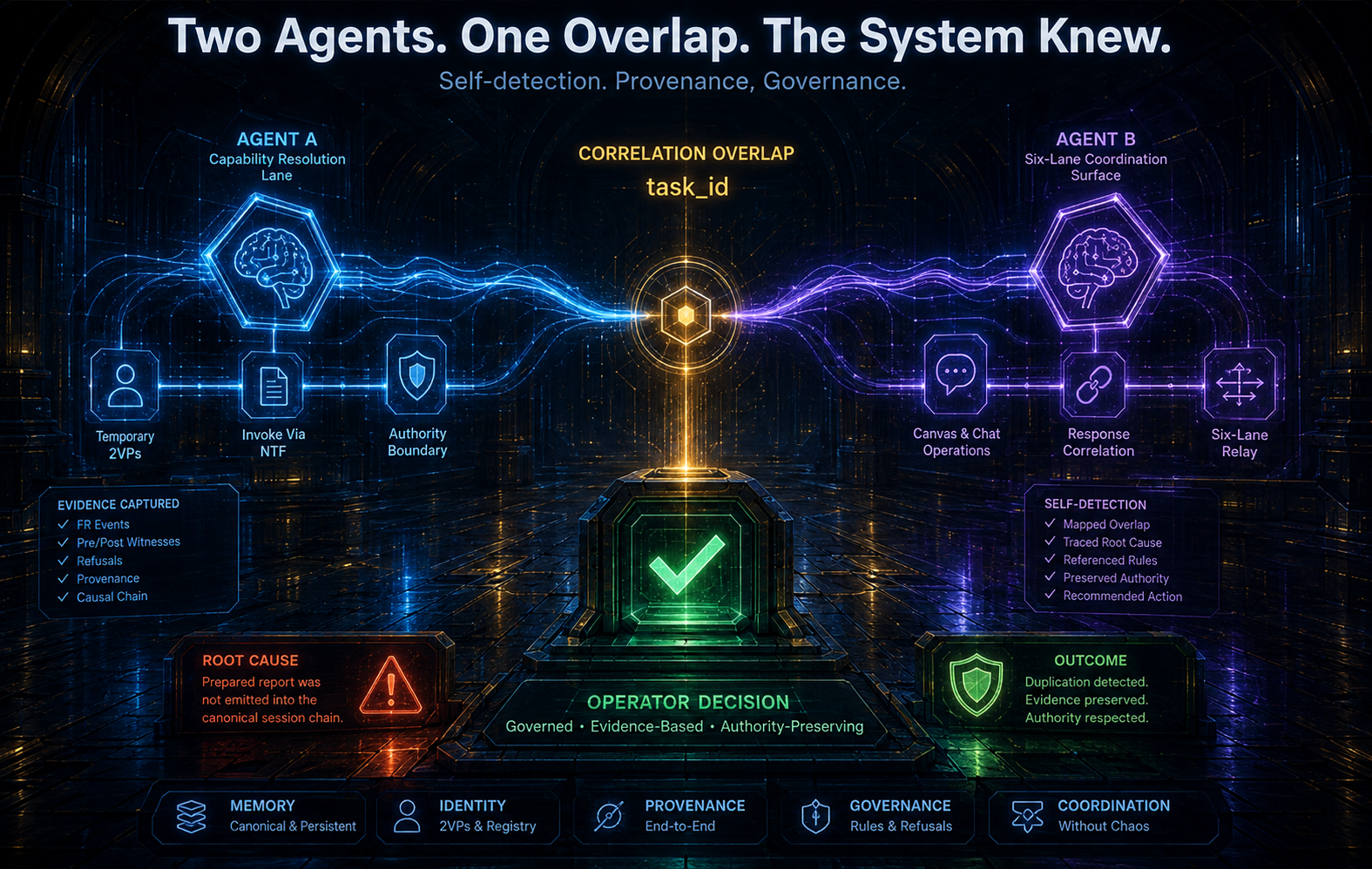
Two agents worked independently. Both were right. Together, they were about to create the wrong architecture. The system noticed before I did.

Work can succeed locally while remaining invisible to the organization. The missing piece was not more activity—it was evidence that the rest of the system could receive and understand what happened.

Detection creates awareness. Governance begins when the warning gains an owner, evidence, a decision point, and follow-through.
Owner-gated agent operations. Every action behind your flip.
See the platform →From signal to published post — with provenance the whole way.
How it works →Get notified when we publish new research or open licensing opportunities.
Distributed intelligence has a difficult problem: how does a system preserve identity, authority, and integrity while its state is constantly changing? Traditional security models answer with credentials, permissions, and expiration times. Those mechanisms establish who may act, but they do not continuously prove that an action still belongs to the system state that originally authorized it.
Read the post →A file is not born governed. It is hash-stamped at birth, compared against everything that came before it, and earns canonical status only through a three-verifier gate.
Read the post →