GovernanceAug 21, 2026
Capability Is Not Authority
Why having the technical power to act is different from having permission to act now, within this scope, under the current rules.
Gavin Voss•4 min read
Sharp, practical notes from the people building owner-gated agent systems.
Why having the technical power to act is different from having permission to act now, within this scope, under the current rules.

How an idea becomes a traceable work item with context, boundaries, evidence, routing, review, and a recorded outcome.
A cautious design direction for observing use of a demoted credential without letting the decoy influence protected state.
A debugging story about a legitimate admission control answering the wrong question inside a one-time authorization gate.
How three security systems that looked alike turned out to protect three completely different boundaries
Checklists don't stop drift. Authority structures do. What we learned building the dual-key gate.
Agent behavior degrades quietly. Here's how to see it before your users do.
Three deployments, three failure modes, one shared fix.
Owner-gated agent operations. Every action behind your flip.
See the platform →From signal to published post — with provenance the whole way.
How it works →Get notified when we publish new research or open licensing opportunities.
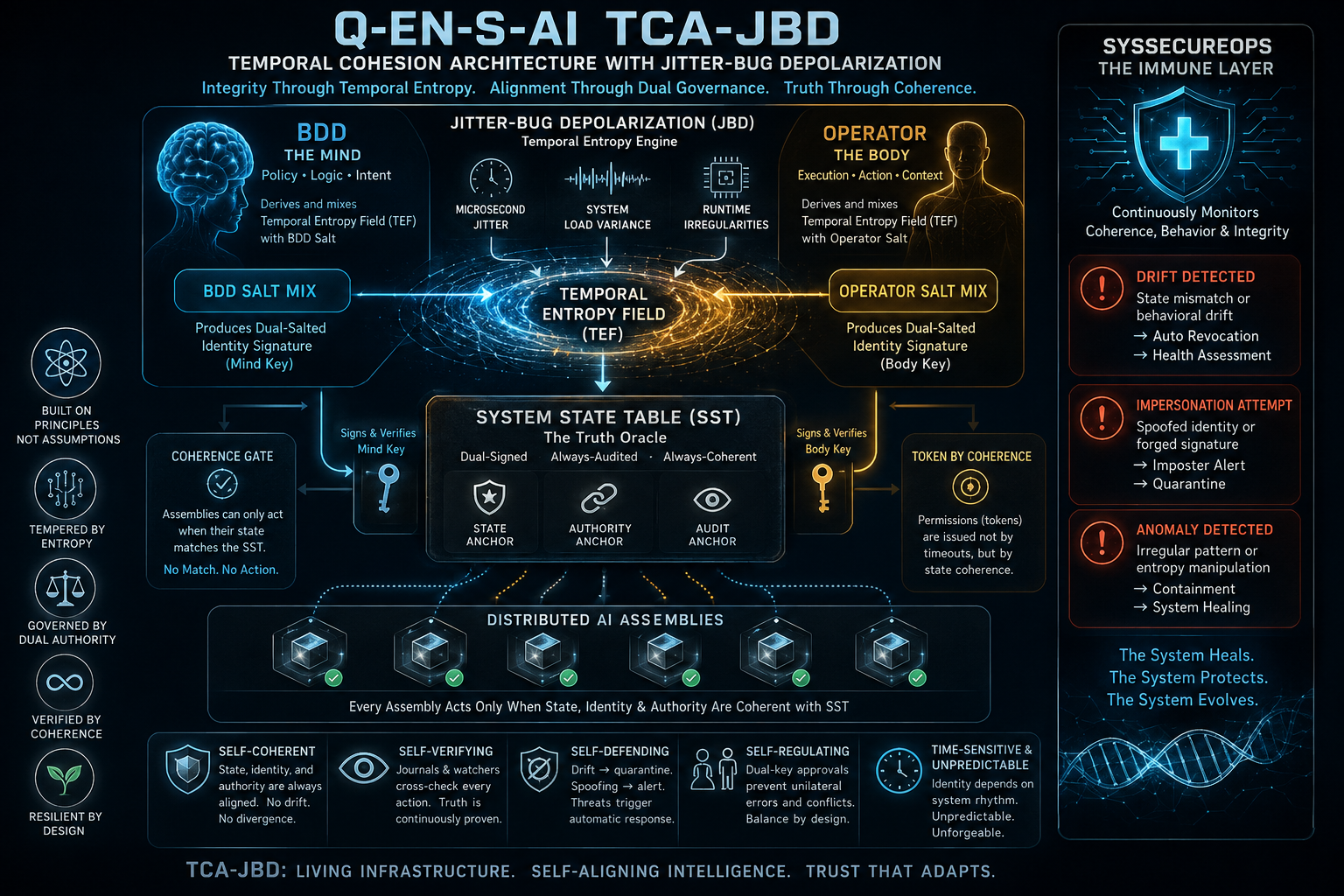
Distributed intelligence has a difficult problem: how does a system preserve identity, authority, and integrity while its state is constantly changing? Traditional security models answer with credentials, permissions, and expiration times. Those mechanisms establish who may act, but they do not continuously prove that an action still belongs to the system state that originally authorized it.
Read the post →A file is not born governed. It is hash-stamped at birth, compared against everything that came before it, and earns canonical status only through a three-verifier gate.
Read the post →