Reading the Verdict
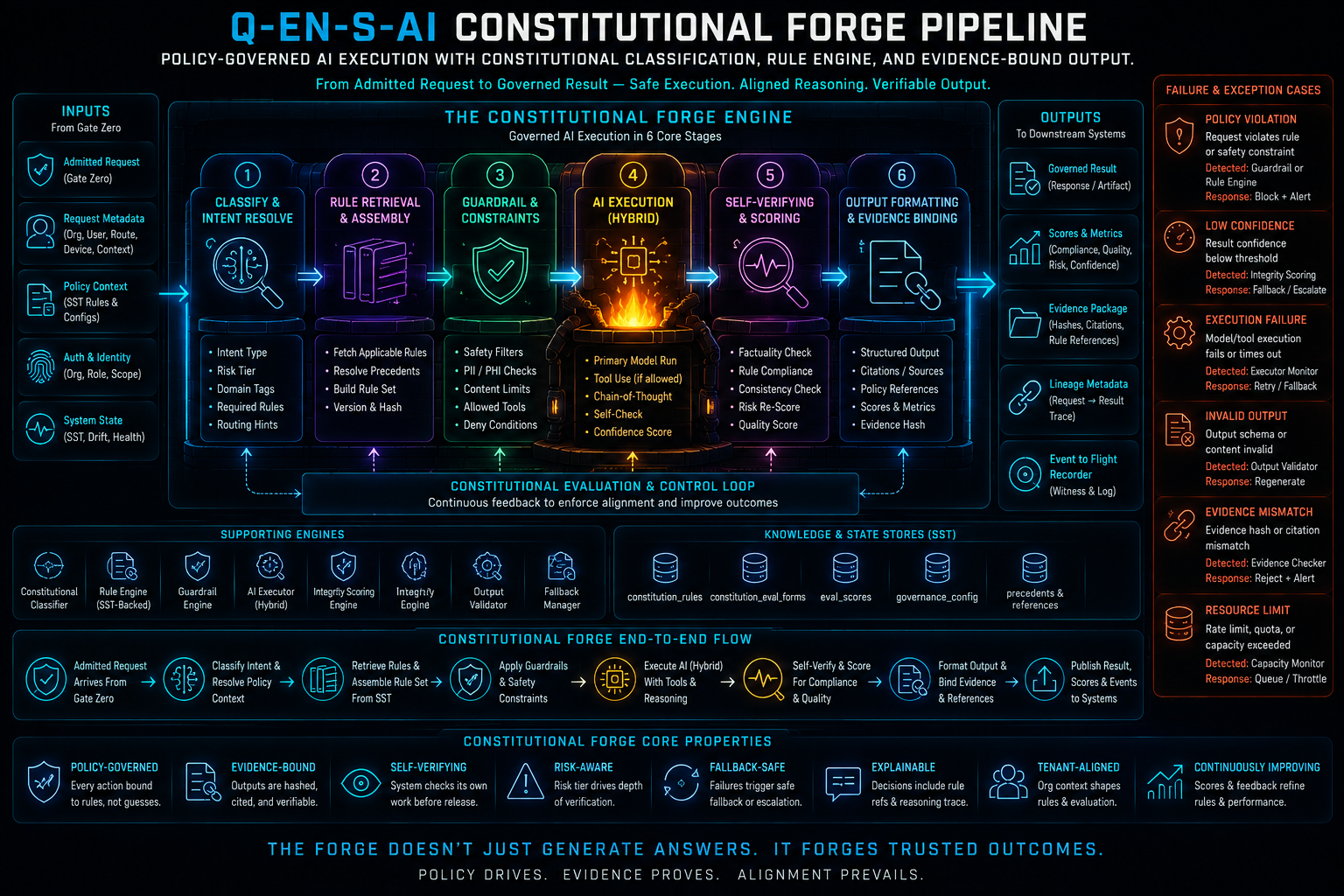
How to read a Forge result like the system does: the five governance domains and the failure each one catches, the seven weighted dimensions inside the Confidence Score, and what to do at each band.
Sharp, practical notes from the people building owner-gated agent systems.
How to read a Forge result like the system does: the five governance domains and the failure each one catches, the seven weighted dimensions inside the Confidence Score, and what to do at each band.

When the constitution is known by all involved, only the transverse of intent need be shared. Less data crosses the wire while more meaning is derived, at a cheaper compute cost. Its dual: independence is what lets a single bit stand for the whole.
Why This Record Exists: This incident captures one of the recurring failure modes that motivated the construction of QENSAI and its governed operating architecture.

We expected research to confirm a product direction. Instead, the evidence narrowed the field, corrected an earlier conclusion, and showed us where confidence was—and was not—earned.
Why having the technical power to act is different from having permission to act now, within this scope, under the current rules.

The loop's first full lap, recapped end to end: a promoted task surfaced two quiet gaps — an alignment score with no seat in the measure system, and a task with no lineage through the gate — and the operator's directive turned both into governance. A keyword-alignment measure was proposed from its nearest sibling, the canonical procedure was authored before any code, and a write path dead since birth was fixed, registered, and passed the gate the same hour.

Standards alignment as a measurement, not a badge — OWASP GenAI Security as the community-front specimen.
Owner-gated agent operations. Every action behind your flip.
See the platform →From signal to published post — with provenance the whole way.
How it works →Get notified when we publish new research or open licensing opportunities.
Distributed intelligence has a difficult problem: how does a system preserve identity, authority, and integrity while its state is constantly changing? Traditional security models answer with credentials, permissions, and expiration times. Those mechanisms establish who may act, but they do not continuously prove that an action still belongs to the system state that originally authorized it.
Read the post →A file is not born governed. It is hash-stamped at birth, compared against everything that came before it, and earns canonical status only through a three-verifier gate.
Read the post →